The Colours I Paint
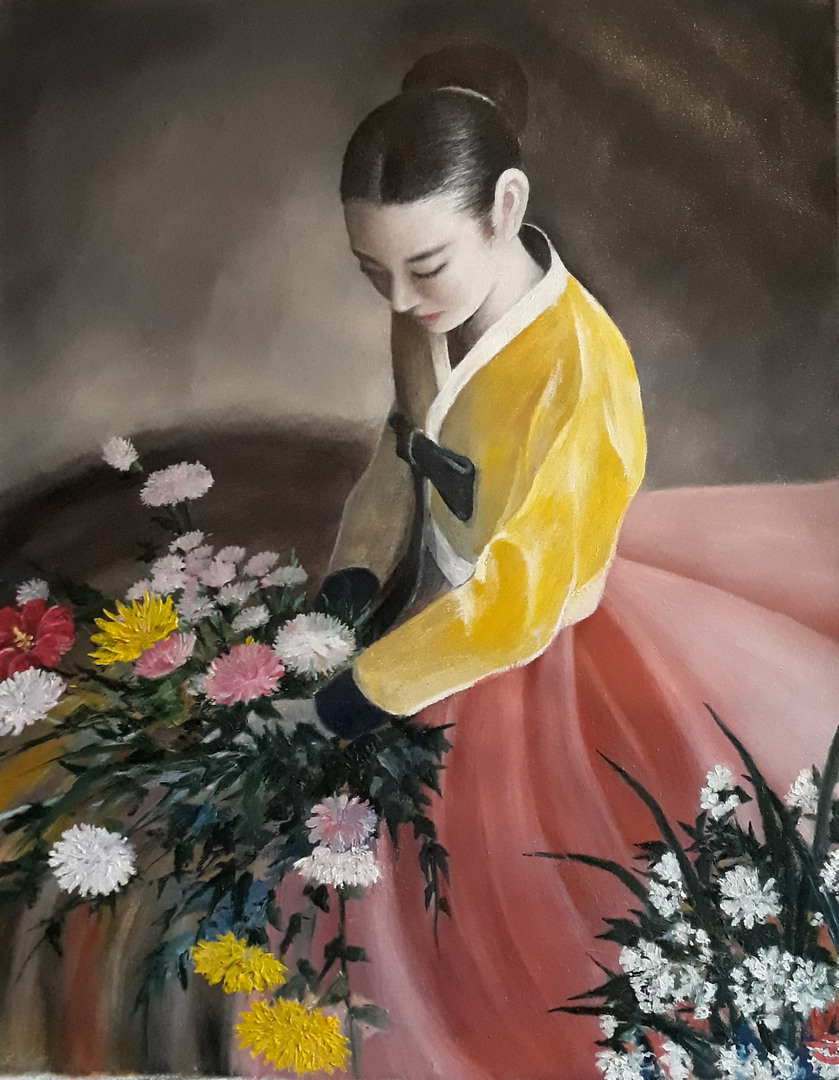
A young woman in a yellow jeogori and pink chima bends over a great bouquet of flowers. She does not look up. Her face is soft, private, absorbed. The flowers — chrysanthemums in white, pink, yellow, and red — spill across her arms like a waterfall of colour. She holds them with the care of someone who knows that beauty is fragile.
The inspiration came from a photograph I took myself while attending a relative’s wedding back in Korea. When I brought that moment to the canvas, I rendered the hanbok with the tenderness of someone who truly remembers what these colours mean — not as a traditional costume, but as living memory. For me, the yellow is the colour of autumn chrysanthemums, of old family photographs, of mothers and grandmothers. The pink is not merely decorative; it is alive and flowing, as if the fabric itself is breathing.
I made the background dark, almost a void. There is no room, no garden, no context. Only the woman and her flowers emerge from the shadow like a figure from a dream. This was deliberate. I wanted to strip away everything except what truly matters: the quiet act of holding beauty, and the calm dignity of a woman who does not need an audience to be beautiful.
There is something deeply Korean about this piece that goes beyond the clothing itself. It captures the way Korean women have always carried beauty — not for display, but as an inherent act of grace. In my painting, she does not pose. She tends. She arranges. She holds the flowers as if they might break, and in doing so, she becomes more beautiful than any of them.