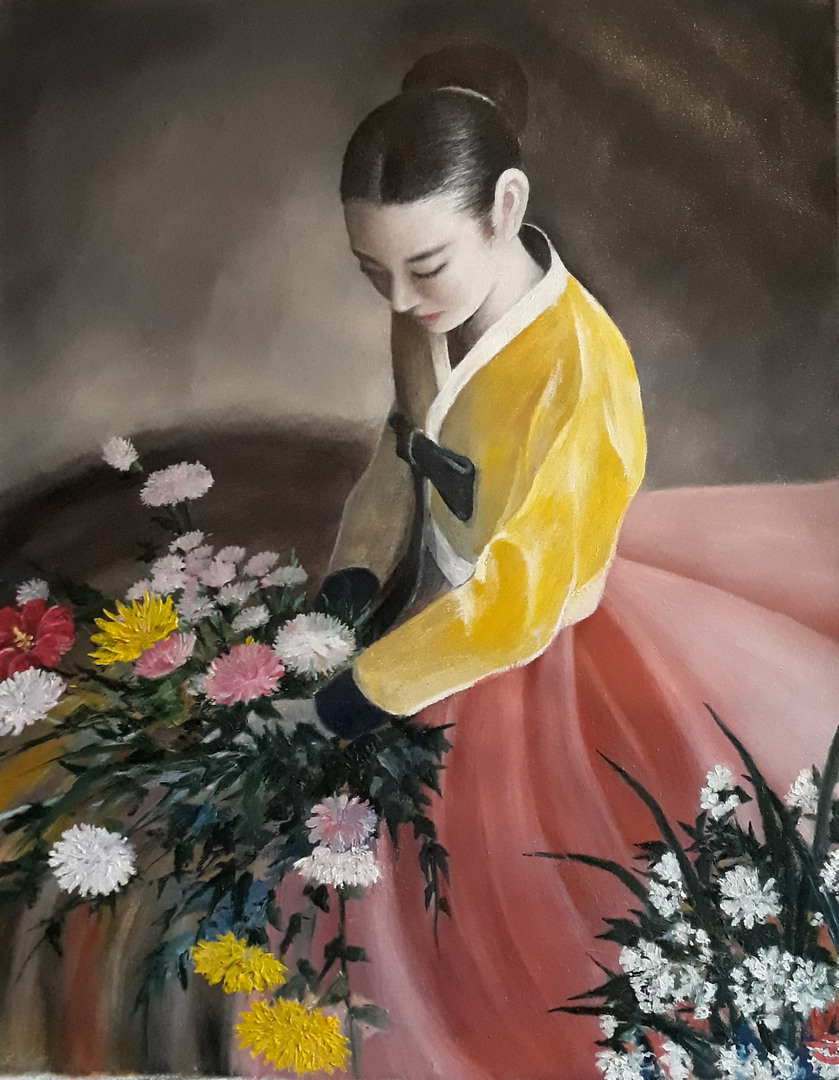
A lady in Korean traditional clothes 

The Colours I Paint

A young woman in a yellow jeogori and pink chima bends over a great bouquet of flowers. She does not look up. Her face is soft, private, absorbed. The flowers — chrysanthemums in white, pink, yellow, and red — spill across her arms like a waterfall of colour. She holds them with the care of someone who knows that beauty is fragile.

The inspiration came from a photograph I took myself while attending a relative’s wedding back in Korea. When I brought that moment to the canvas, I rendered the hanbok with the tenderness of someone who truly remembers what these colours mean — not as a traditional costume, but as living memory. For me, the yellow is the colour of autumn chrysanthemums, of old family photographs, of mothers and grandmothers. The pink is not merely decorative; it is alive and flowing, as if the fabric itself is breathing.

I made the background dark, almost a void. There is no room, no garden, no context. Only the woman and her flowers emerge from the shadow like a figure from a dream. This was deliberate. I wanted to strip away everything except what truly matters: the quiet act of holding beauty, and the calm dignity of a woman who does not need an audience to be beautiful.

There is something deeply Korean about this piece that goes beyond the clothing itself. It captures the way Korean women have always carried beauty — not for display, but as an inherent act of grace. In my painting, she does not pose. She tends. She arranges. She holds the flowers as if they might break, and in doing so, she becomes more beautiful than any of them.
The Smile That Arrives First

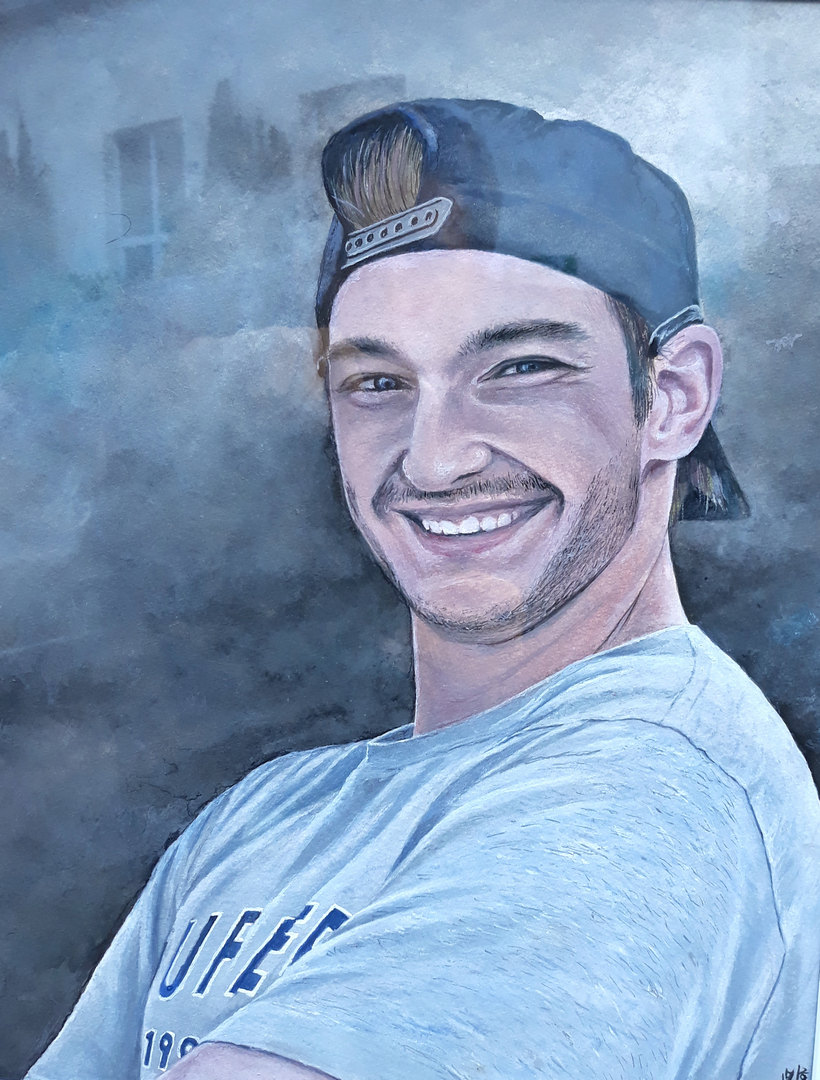
Water Colour on 300 GSM paper (41 x 28 cm)

A young man turns toward me with a smile so wide and genuine it feels like sunlight breaking through clouds. His blue baseball cap sits backwards, his light blue t-shirt is casual, and his eyes crinkle at the corners the way they do when someone laughs before they’ve even decided to.

I painted this portrait when I first moved to Dunedin and was working as a part-time night support worker. The subject of the painting was a client of mine at the time. He was a young Kiwi, just a year or two younger than my eldest son. Even though there was a bit of an age difference, he took to me so well and we shared a close, genuine bond. He was going through a very difficult time back then, facing significant challenges in his life. I painted this for him as a heartfelt gift, hoping it would give him the strength and encouragement he needed to overcome those hardships.

While I almost always paint portraits in oil, I decided to use watercolour for this piece. Watercolour is a medium that does not forgive; every stroke is permanent, and every shadow is an absolute commitment. Despite the challenge, choosing watercolour allowed me to capture a level of fine detail and precision that gave me a deep, rewarding sense of accomplishment when it was finished. The effect feels effortless—his skin has warmth, his stubble has texture, and his smile has the particular quality of someone who truly means it.

What stands out most in this piece is the profound trust between us. A portrait like this requires the subject to be completely relaxed, to allow themselves to be deeply seen, and to be captured in a moment of unguarded joy. He wasn’t performing or posing for me. He was simply happy in that moment, and the painting captures that rare, unselfconscious radiance.

I let the background dissolve into soft blue-grey washes—perhaps a street, perhaps a building, it doesn’t matter. Everything secondary has been reduced to atmosphere so that his face—the smile, the eyes, the slight tilt of the head—can speak without interruption.

This is what I always strive to achieve with watercolour: to paint people the way a friend remembers them. Not too much photorealistic, not idealised, but deeply felt.

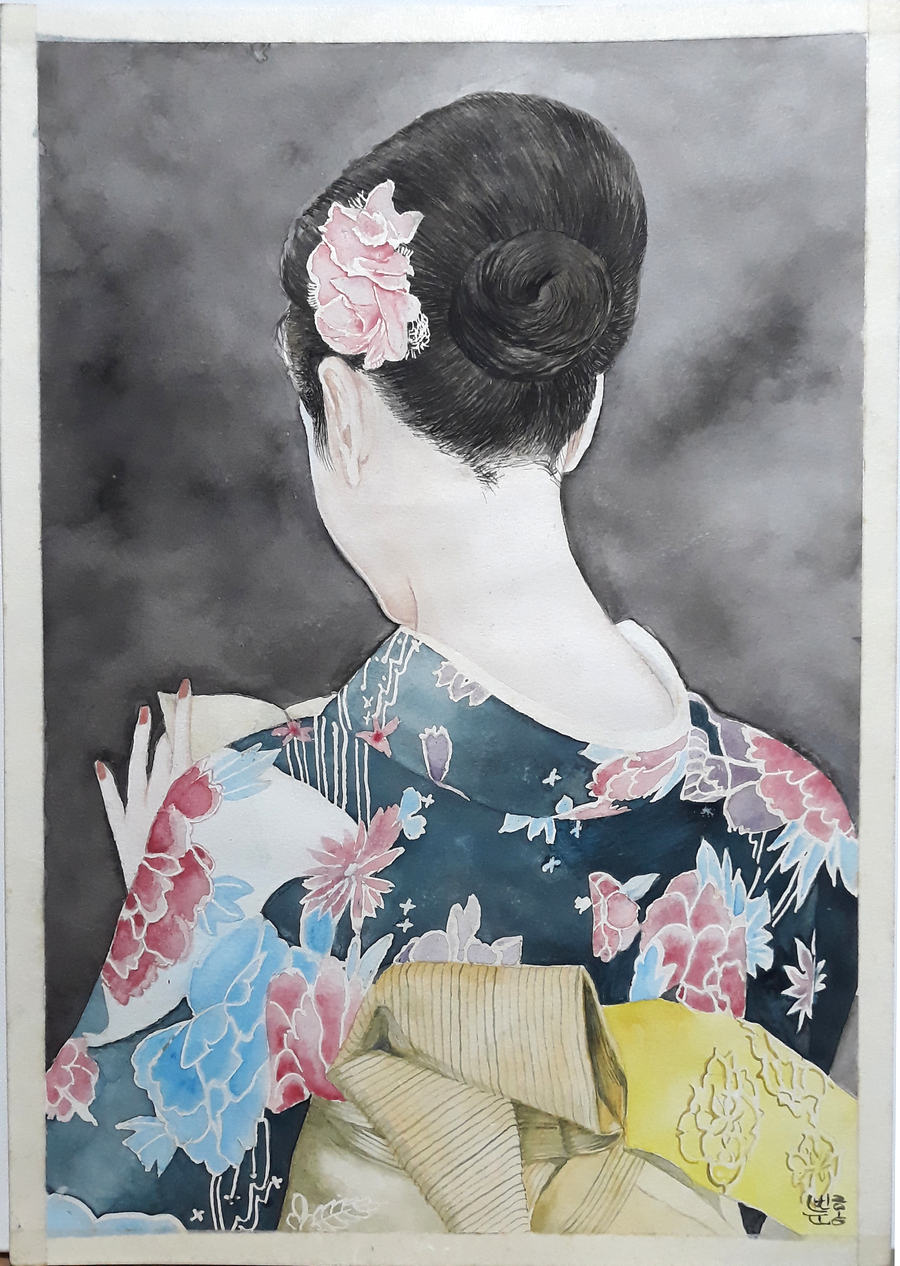
A lady in Kimono – The One I Didn’t Know

Water Colour on 300 GSM paper (41 x 28 cm)

This piece began as a photograph I took during a trip to Japan around 2014, at a local summer festival. A woman stood ahead of me, seen only from behind, and something about her stillness — the way her neck curved into her shoulders, the cascade of her kimono catching the light — made me reach for my camera without thinking. I didn’t know her name. I never saw her face. But that back view stayed with me for years.

I returned to the photograph in 2016 and began to paint. By then, the moment had already become something else in my memory — quieter, more timeless. Where she had been reading from a phone, I placed a book in her hand, as if shifting her gently into an older, slower world. I elongated her neck and softened her frame, making her more slender than she was in life, because what I remembered was not her body but the feeling of her grace.

The kimono is deep navy, almost indigo, painted in layers of watercolor wash that shift between shadow and sea. Across it bloom large peonies — pink, pale blue, and crimson — their petals loose and bleeding into the fabric as though the flowers are growing out of the silk itself. Small star-like motifs and fine white lines scatter between them, like breath or dust catching lamplight.

Her hair is gathered into a tight, dark bun, coiled with the precision of a brushstroke. Tucked just above her left ear, I placed a cluster of soft pink blossoms with delicate white lace beneath — a kanzashi, a hair ornament that belongs to festivals and fleeting afternoons. It is the only warm colour near her face, and it draws the eye the way the original moment drew mine.

Her right hand rises from the sleeve, pale and deliberate, fingers extended against the open page of the book. The obi at her waist is a muted gold-yellow, embossed with faint floral patterns and folded in structured pleats that contrast with the fluidity of everything above it.

The background is an atmospheric wash of grey, layered and cloudy, as if the festival noise — the lanterns, the music, the crowd — has been dissolved away, leaving only her, suspended in silence.

I painted her from behind because that is how I met her. And perhaps that is why she remains beautiful — because she was never fully mine to know. She was a moment, a glance, a photograph held for three years before it became a painting.