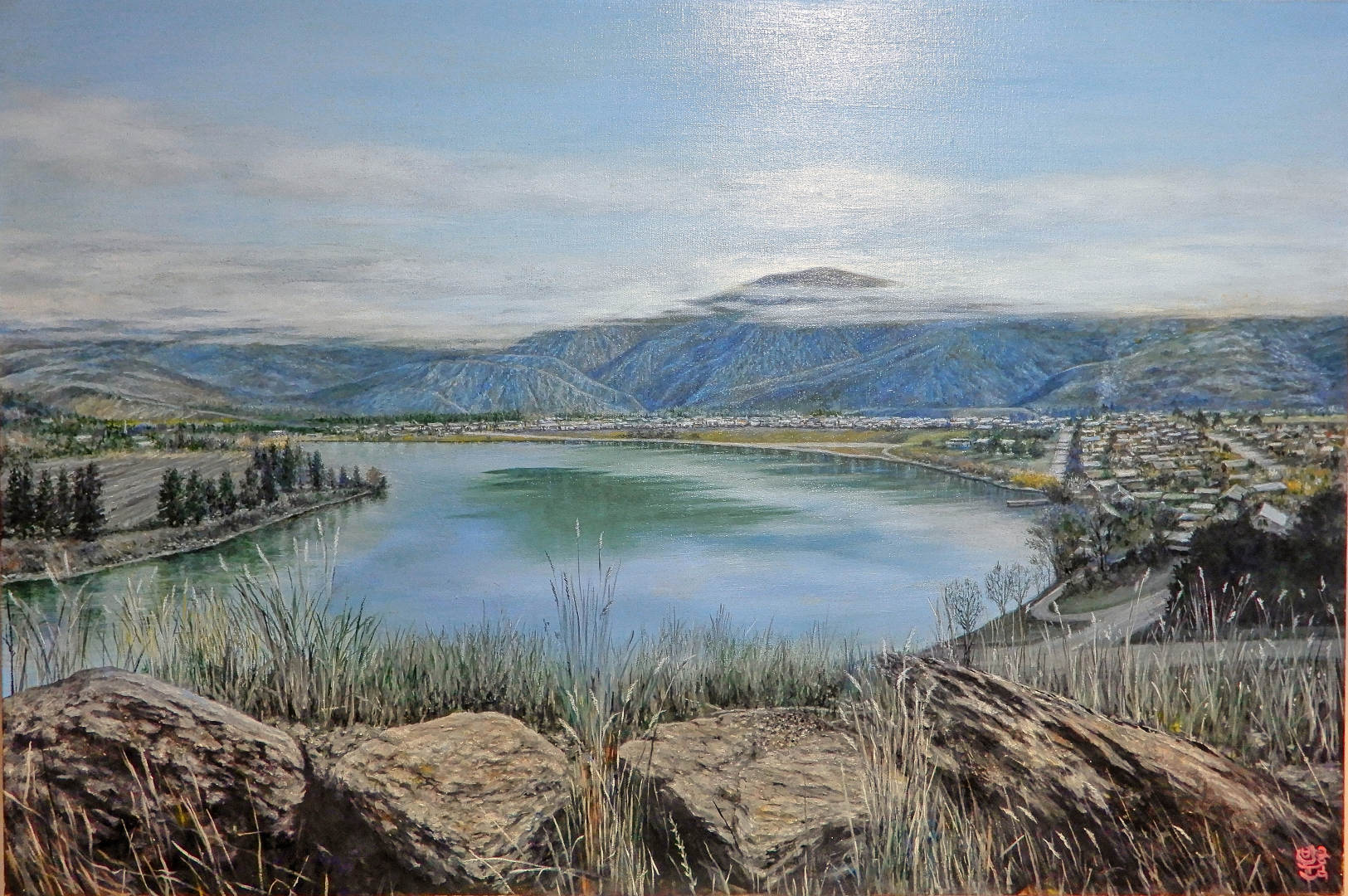
Cromwell, in the Low Clouds

90 x 60 cm / Oil / Canvas

Every time I visited Queenstown from Dunedin, Cromwell was always my stop. Before reaching Cromwell, there is a small bridge — and I always pull over there. You have to get out of the car. It is the most beautiful vantage point to take in the view.

That day, the clouds had descended low, hanging heavy and slow across the valley. The air felt thick with something unspoken — the kind of quiet that makes you want to paint. So I did.

The lake stretches out in the middle distance, its surface holding the light like a mirror made of glass and memory. On the left, the orchards and vineyards line the shore; on the right, the small town of Cromwell sprawls gently. And above it all, the mountains rise in layers — pale blue ridges stacking one behind the other, until the eye finds that flat-topped peak standing alone in the center, a landmark that feels like the spine of the landscape.

In the foreground, the rocks sit heavy and weathered. The grasses bend with the wind, catching the light in their tips. I painted the rocks with care — every crack, every shadow, every rough edge. I wanted the viewer to feel the weight of stone beneath their feet.

The feeling of this painting is solitude, but not loneliness. It is the solitude of someone who has found a place that feels like home, even if only for a moment. The clouds are low, the water is calm, and the town below is small and peaceful — smaller than most places, quieter, as if the world itself has decided to slow down here.

I think the painting is not really about Cromwell. It is about that moment when you stop, when you step out of the car, when you look at the view and realize — this is why you came. This is the place that waits for you.

That is Cromwell. That is the bridge before the bridge. That is the view I always come back to.
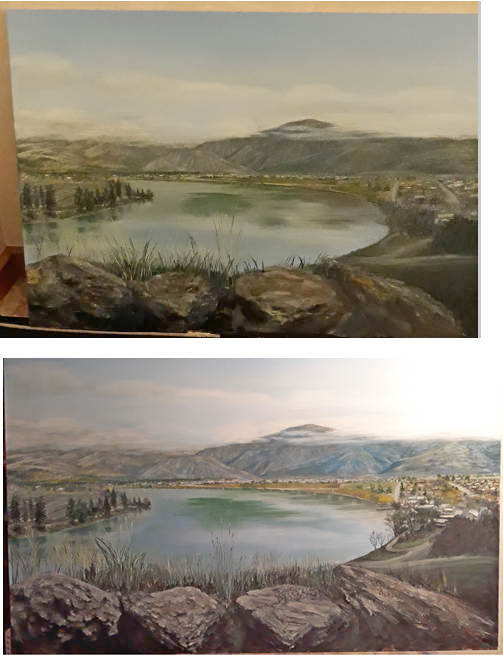
Work in Progres

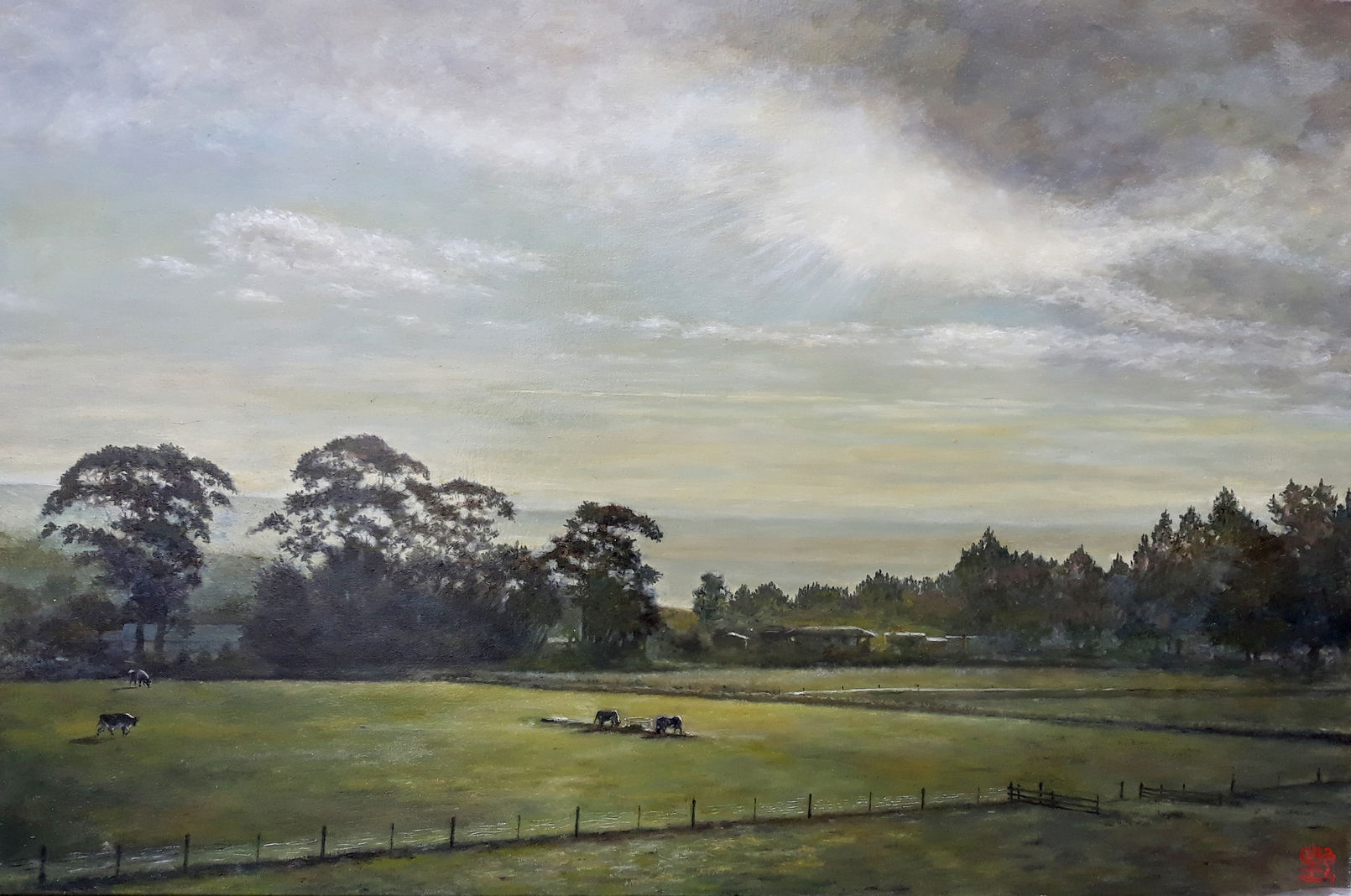
A Quiet Evening, Oaramu

90 x 60 cm / Oil / Canvas

When I look at this painting, I remember wanting the sky to carry the weight of the entire piece. I gave the clouds almost all of the work to do, painting them in a long, slow, horizontal rhythm that stretches from left to right across most of the canvas. Low above the horizon, just over the trees, I painted a thin band of pale light—not the fire of a sunset, but that specific, soft yellow-green light that comes after the day has already let go. It’s the color of the last minutes before a winter evening, when the day is quietly folding its hands.

Below that vast sky, I wanted the land to feel completely calm. I laid out a wide green paddock stretching across the foreground. To the far left, near the trees, I placed a single cow grazing alone, balanced in the middle of the field by a small group of three standing close together, heads down, just doing their slow cow things. I anchored the bottom of the canvas with a simple wooden fence, leaving a small gate open on the right—a quiet doorway back into the field, waiting for no one in particular.

I used the trees to frame the scene like a quiet audience. On the left, I gathered a cluster of tall, dark trees, painting them almost like a small crowd leaning in. On the right, I ran a row of pines. In the space between them, I let a few small farm buildings sit low and quiet on the horizon, deliberately letting them get almost swallowed by the haze.

My goal for this piece was stillness. Not emptiness—the field is full of grass, full of life, and full of small presences—but the very quiet end of a long day. I wanted the cows to feel completely unaware of being watched, and the trees to remain perfectly still. I painted the clouds as if they had slowed down on purpose, just to stay a little longer.

For me, this painting isn’t really about the farm itself. It’s about capturing that one thin, fleeting moment when the day changes—when light becomes memory—and everything in the world seems to hold its breath for a second before night comes. That is what Oaramu in the evening means to me.

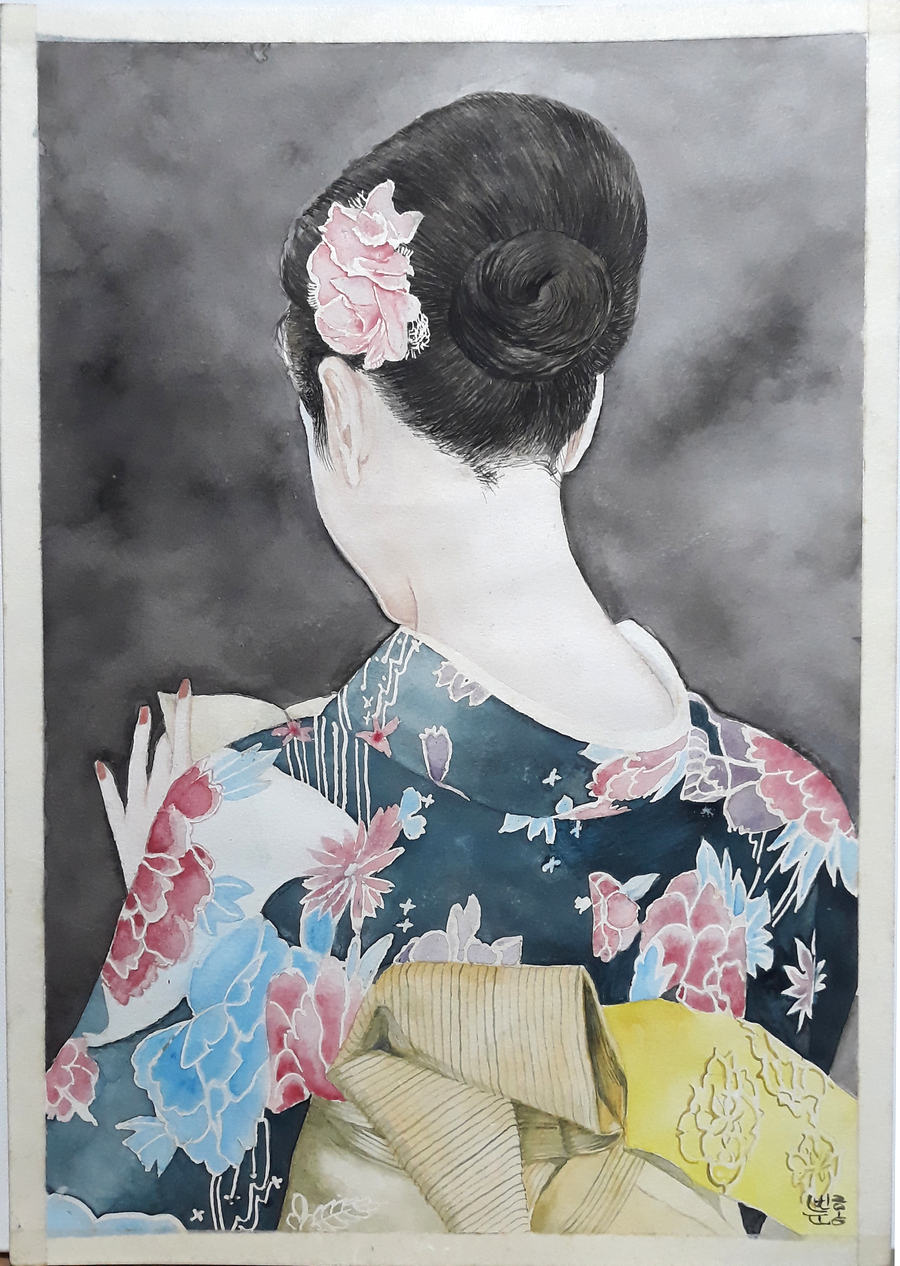
A lady in Kimono – The One I Didn’t Know

Water Colour on 300 GSM paper (41 x 28 cm)

This piece began as a photograph I took during a trip to Japan around 2014, at a local summer festival. A woman stood ahead of me, seen only from behind, and something about her stillness — the way her neck curved into her shoulders, the cascade of her kimono catching the light — made me reach for my camera without thinking. I didn’t know her name. I never saw her face. But that back view stayed with me for years.

I returned to the photograph in 2016 and began to paint. By then, the moment had already become something else in my memory — quieter, more timeless. Where she had been reading from a phone, I placed a book in her hand, as if shifting her gently into an older, slower world. I elongated her neck and softened her frame, making her more slender than she was in life, because what I remembered was not her body but the feeling of her grace.

The kimono is deep navy, almost indigo, painted in layers of watercolor wash that shift between shadow and sea. Across it bloom large peonies — pink, pale blue, and crimson — their petals loose and bleeding into the fabric as though the flowers are growing out of the silk itself. Small star-like motifs and fine white lines scatter between them, like breath or dust catching lamplight.

Her hair is gathered into a tight, dark bun, coiled with the precision of a brushstroke. Tucked just above her left ear, I placed a cluster of soft pink blossoms with delicate white lace beneath — a kanzashi, a hair ornament that belongs to festivals and fleeting afternoons. It is the only warm colour near her face, and it draws the eye the way the original moment drew mine.

Her right hand rises from the sleeve, pale and deliberate, fingers extended against the open page of the book. The obi at her waist is a muted gold-yellow, embossed with faint floral patterns and folded in structured pleats that contrast with the fluidity of everything above it.

The background is an atmospheric wash of grey, layered and cloudy, as if the festival noise — the lanterns, the music, the crowd — has been dissolved away, leaving only her, suspended in silence.

I painted her from behind because that is how I met her. And perhaps that is why she remains beautiful — because she was never fully mine to know. She was a moment, a glance, a photograph held for three years before it became a painting.