The Smile That Arrives First

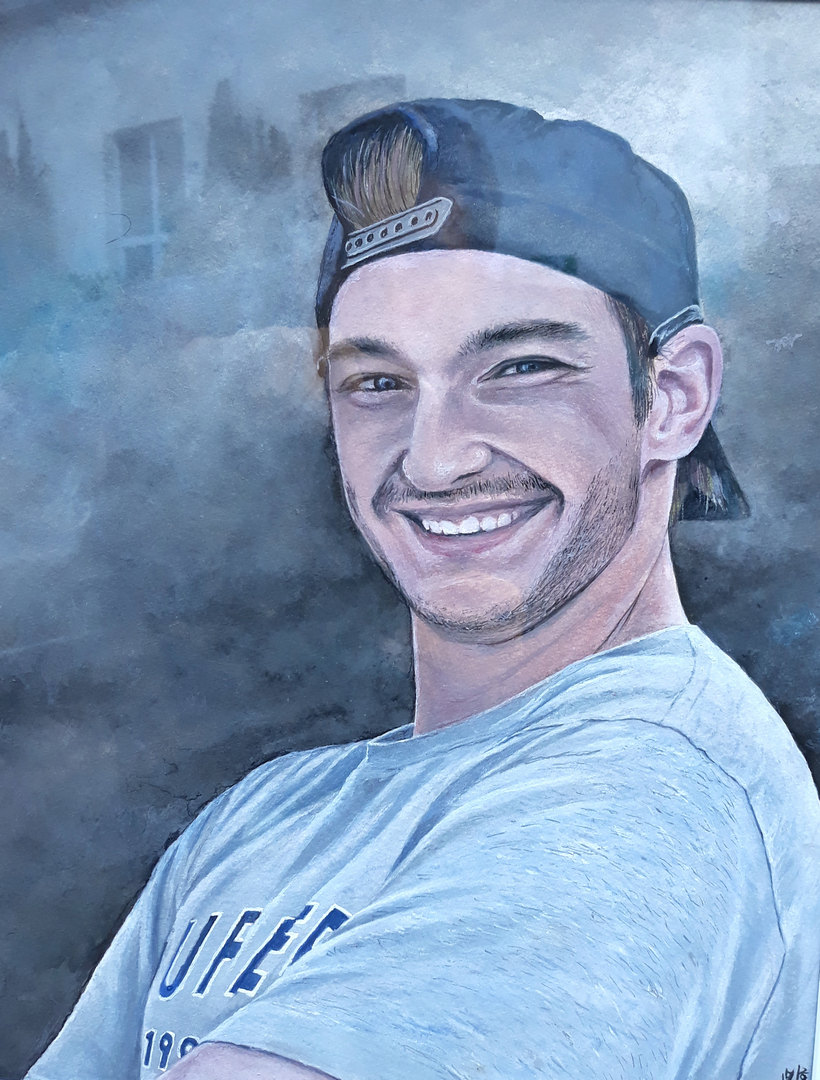
Water Colour on 300 GSM paper (41 x 28 cm)

A young man turns toward me with a smile so wide and genuine it feels like sunlight breaking through clouds. His blue baseball cap sits backwards, his light blue t-shirt is casual, and his eyes crinkle at the corners the way they do when someone laughs before they’ve even decided to.

I painted this portrait when I first moved to Dunedin and was working as a part-time night support worker. The subject of the painting was a client of mine at the time. He was a young Kiwi, just a year or two younger than my eldest son. Even though there was a bit of an age difference, he took to me so well and we shared a close, genuine bond. He was going through a very difficult time back then, facing significant challenges in his life. I painted this for him as a heartfelt gift, hoping it would give him the strength and encouragement he needed to overcome those hardships.

While I almost always paint portraits in oil, I decided to use watercolour for this piece. Watercolour is a medium that does not forgive; every stroke is permanent, and every shadow is an absolute commitment. Despite the challenge, choosing watercolour allowed me to capture a level of fine detail and precision that gave me a deep, rewarding sense of accomplishment when it was finished. The effect feels effortless—his skin has warmth, his stubble has texture, and his smile has the particular quality of someone who truly means it.

What stands out most in this piece is the profound trust between us. A portrait like this requires the subject to be completely relaxed, to allow themselves to be deeply seen, and to be captured in a moment of unguarded joy. He wasn’t performing or posing for me. He was simply happy in that moment, and the painting captures that rare, unselfconscious radiance.

I let the background dissolve into soft blue-grey washes—perhaps a street, perhaps a building, it doesn’t matter. Everything secondary has been reduced to atmosphere so that his face—the smile, the eyes, the slight tilt of the head—can speak without interruption.

This is what I always strive to achieve with watercolour: to paint people the way a friend remembers them. Not too much photorealistic, not idealised, but deeply felt.
Low Tide Serenity in Milford Sound

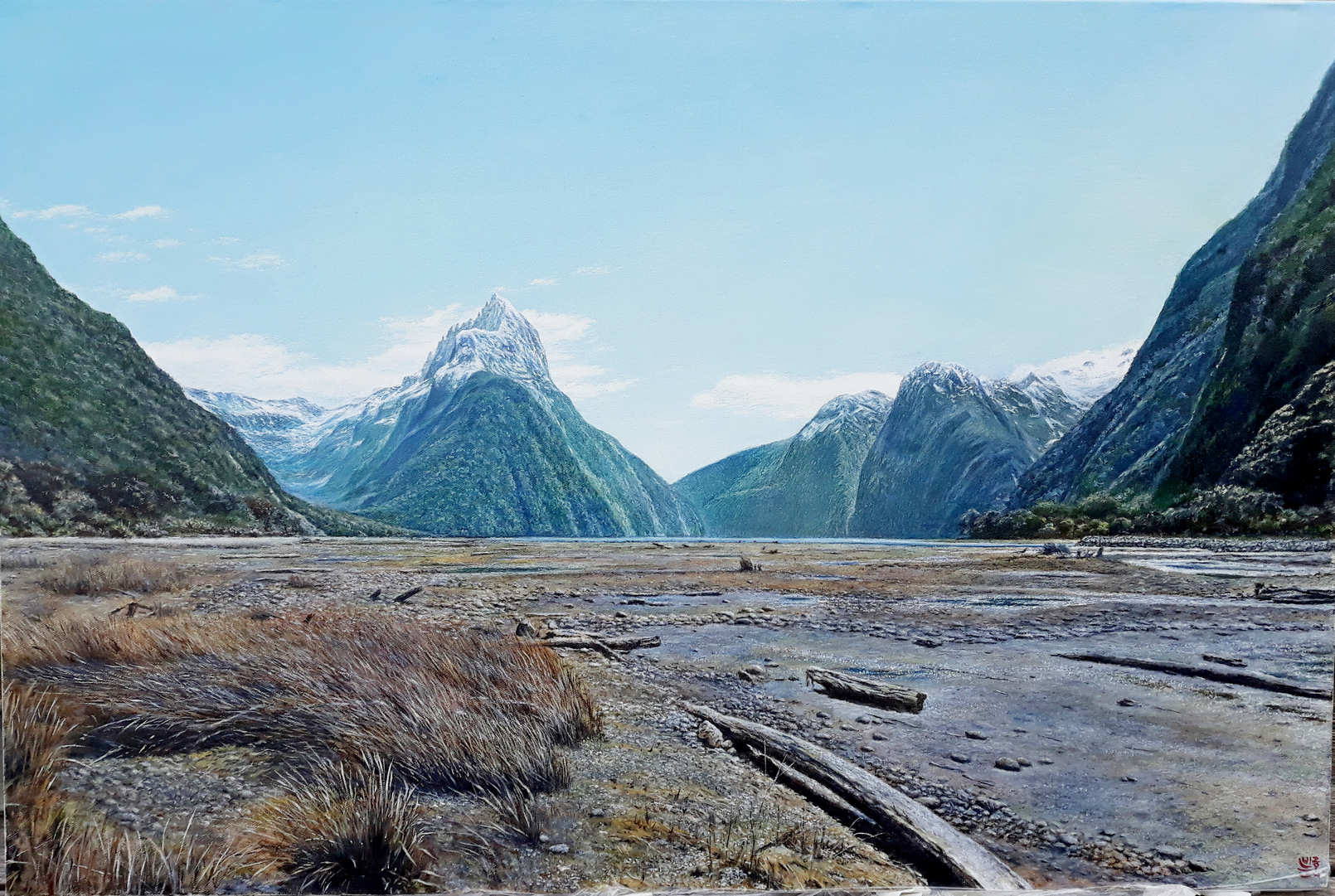
90 x 60 cm / Oil / Canvas

Most painters approach Milford Sound with reverence for its most celebrated form — water filling the valley, mirror-perfect reflections, dramatic light. That is the postcard. That is the expectation.

I painted the day the water left.

Work in Progress

What remains when the tide retreats is not emptiness. It is evidence. Driftwood smoothed by decades of current, stones polished by patient water, tussock grass holding its ground against the alpine wind. These are the things the Sound hides beneath its beauty — and I chose to show them.

The light that day was not my usual ally. No golden hour. No storm clouds gathering. Just bright, honest, unflinching daylight. Most landscape painters would have waited for a more dramatic sky. I saw that brightness not as absence of drama, but as presence of truth.

Mitre Peak still commands the center — the mountain does not need drama to be great. It simply is. And perhaps that is what my painting says: beauty does not always announce itself with fire and reflection. Sometimes it waits quietly beneath the surface, and asks only to be seen when the water steps aside.

What I painted was not a view. It was a choice — to look where others look away, to find beauty in what the landscape reveals only when it thinks no one is watching.

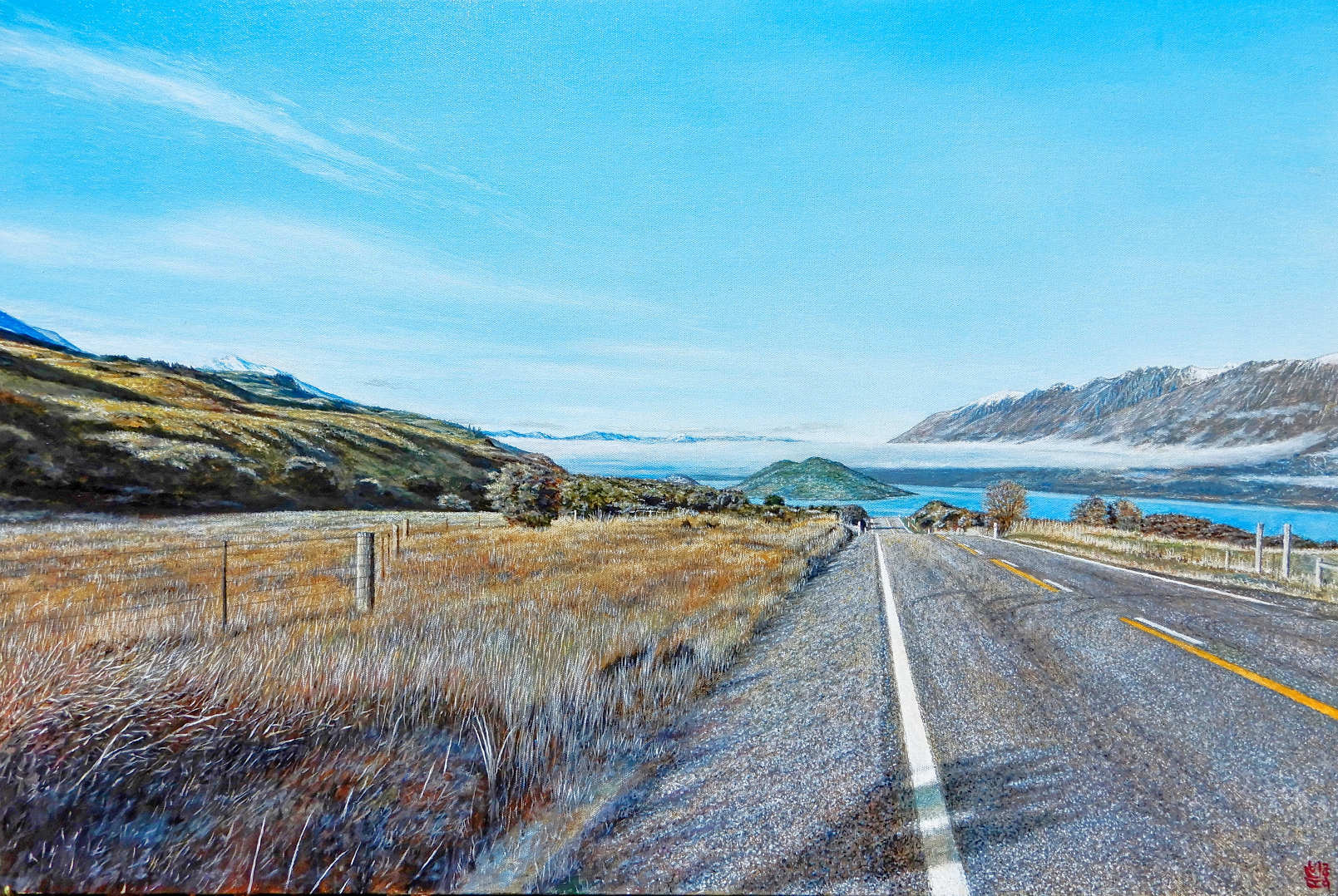
On the way to Glenorchy

90 x 60 cm / Oil / Canvas

There is a particular kind of freedom that only comes when you are truly alone on the road—a silence so profound it becomes a language of its own. Looking back at this piece, I am drawn back to the stillness I found on the way to Glenorchy. It wasn’t just the landscape that captivated me—the way the afternoon light stretched across the valley and the distant mountains whispered in the quiet—but the feeling of being a traveler with no destination in mind, only the road unfolding ahead.

In the painting, the long, stretched-out cloud resting serenely along the mountain range reminds me of the essence of this land—the ‘Aotearoa,’ the Land of the Long White Cloud. That singular cloud feels like a silent guardian of the peaks, adding a touch of legendary serenity to the scene. I remember the sharp, crisp air of that day and the vastness of the space around me; it was a quiet solitude that felt more like an invitation than an absence of company.

I often revisit this moment in my mind, a time when the world felt boundless and I was simply a guest passing through. It captures a fleeting breath of time where the weight of life was replaced by the light. The brushstrokes still seem to carry the warmth of that afternoon, reminding me that even when the journey is solitary, the beauty we encounter along the way is enough to make us feel entirely, beautifully free.