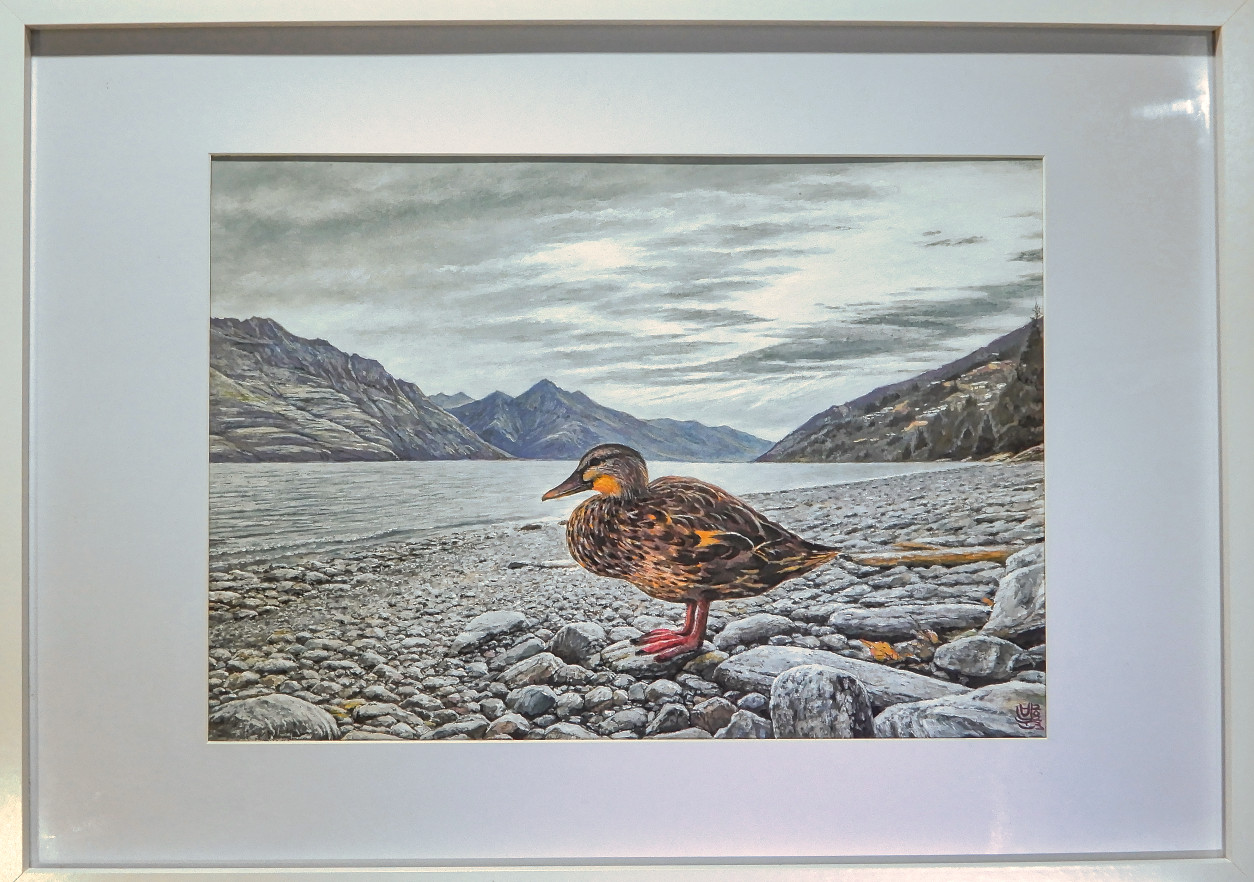
A duck stands alone on the rocky shore of Lake Wakatipu. It is not dramatic—no golden light, just grey water, grey mountains, and one small bird, perfectly still.
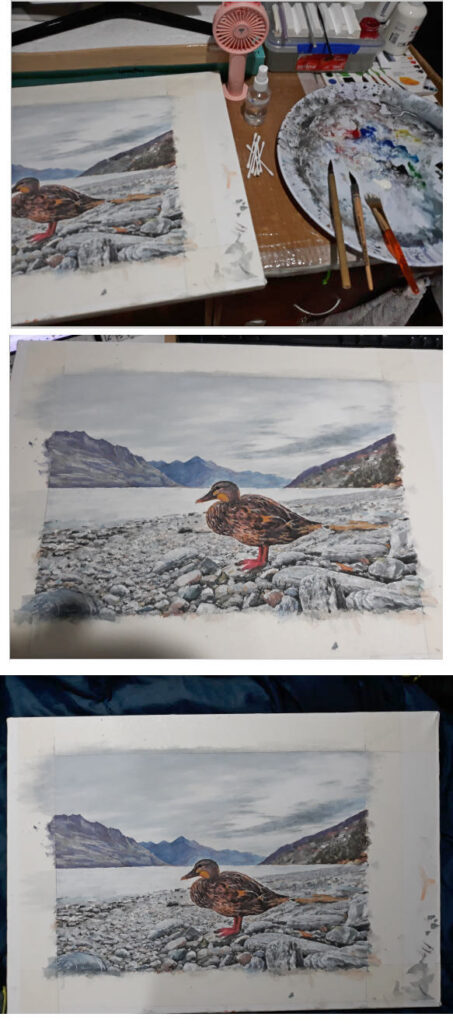
I painted this from a photo I took during a trip to Queenstown. After I finished sharing my snacks, this duck didn’t wander off; it stayed by my side. I lay flat to get to its eye level, and it stood like a professional model. I captured that exact moment and later brought it to life on watercolour paper.
I wanted to paint the kind of solitude most artists decorate, but I resisted. The watercolour is precise—each pebble and ripple has character—but the effect is hushed. The duck does not perform; it simply exists. This is Queenstown at its most honest, not the tourist postcard colours, but the lake on an ordinary afternoon: vast, indifferent, and quietly magnificent.
I eventually gifted this painting to a dear friend who journeyed from Nelson to Dunedin just to see me. Through this piece, I wanted to share a quiet reflection: to be alone is not to be lonely. The duck is complete.
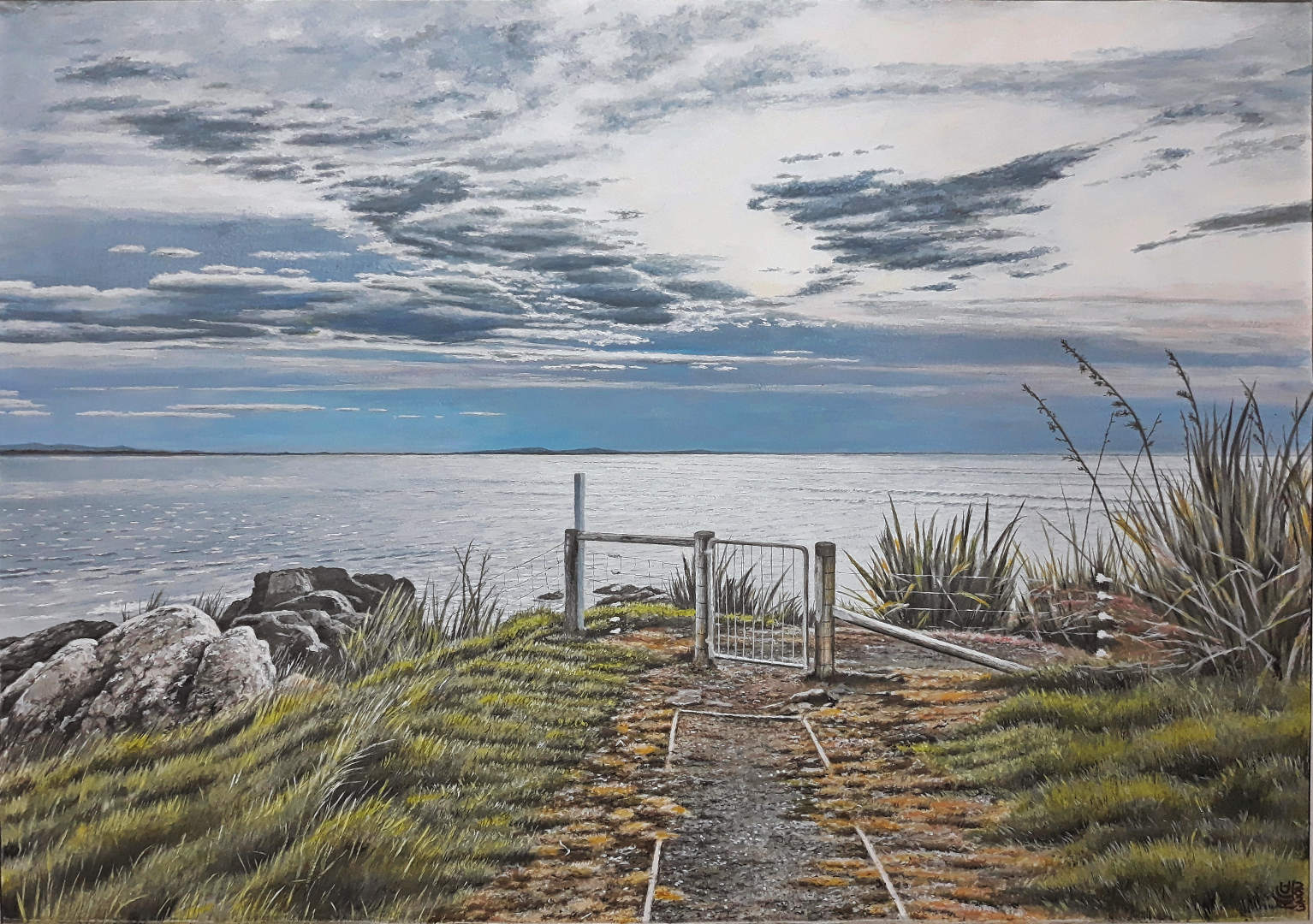
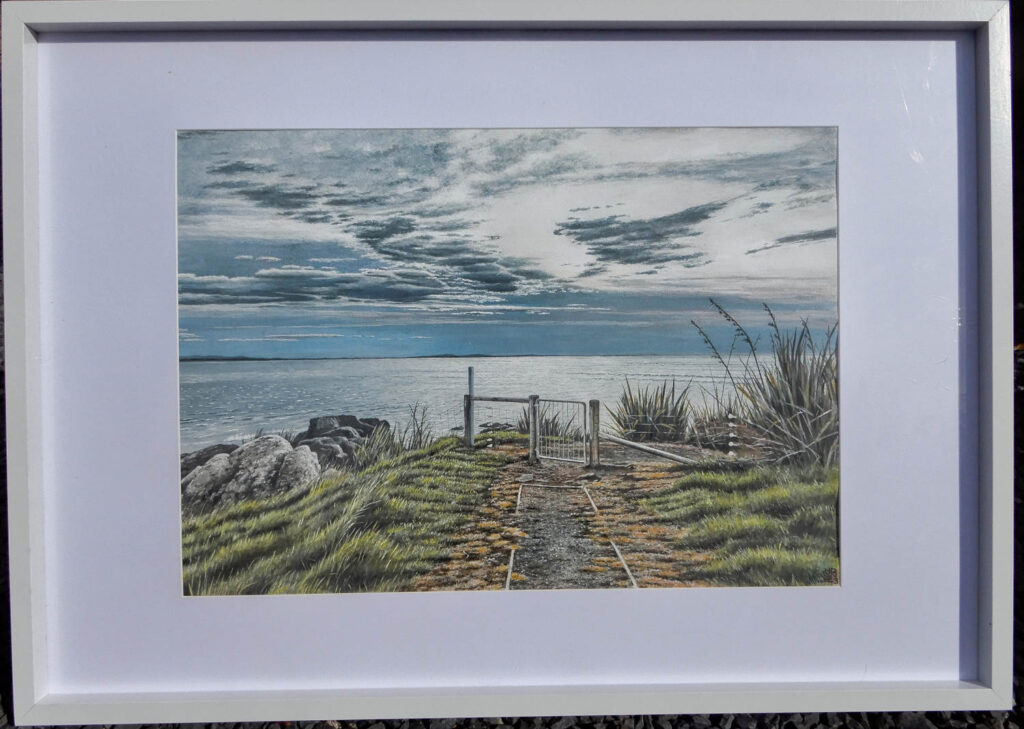
I have stood on this shore more times than I can count. Riverton is one of those places where you don’t just visit — you return. Every time, the light is different. Every time, the wind carries something new.
That day, the sky was doing what it always does here — changing. The clouds hung low and heavy on one side, but broke open on the other, letting pale blue slip through. The kind of sky that makes you want to stop the car, step out, and just look.
The path leads straight to the sea. A simple gravel track, worn smooth by feet and time. And there it stands — a gate, half-open. Not locked. Not closed. Just… open. As if the land itself is inviting you forward. As if it has been waiting.
On the right, harakeke flax rises tall and sharp, its leaves catching the wind like fingers. On the left, weathered rocks sit low and patient — the kind of rocks that have seen centuries of tides, storms, and quiet mornings. They don’t move. They don’t need to.
The sea stretches out wide and still. In the distance, the faint outline of land — maybe Stewart Island, maybe just a trick of the light. The horizon is long and unhurried. There is no rush here. No urgency. Just the slow breathing of water and wind.
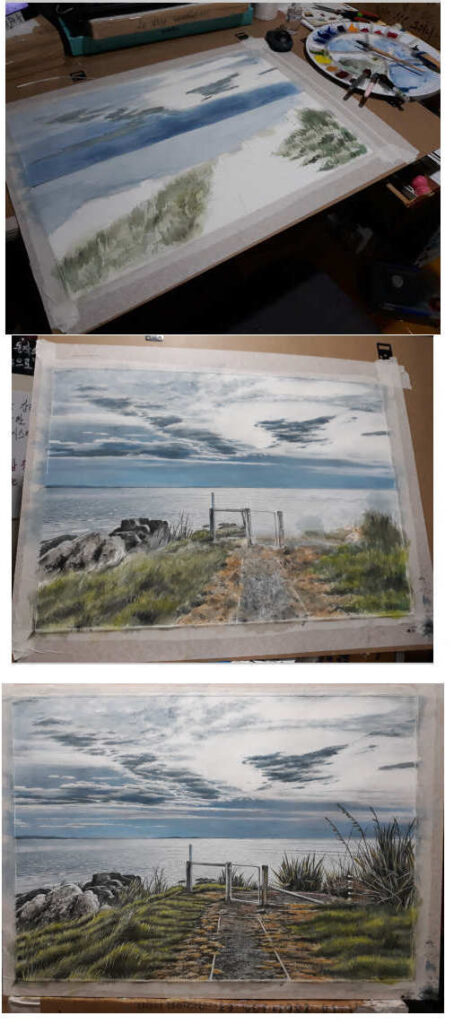
When I paint realistically, I work in oils. Oil gives me time — time to layer, to adjust, to build depth slowly. But this piece is watercolour. Watercolour is unforgiving. It dries fast. It doesn’t let you correct. The water moves on its own, and you have to coax it, not control it. Normally, when I work in watercolour, I paint loose — I mix realism with abstraction, let the water do its own thing, feel the joy of letting go. But this painting is different. There is almost no abstraction here. It leans hard into realism, chasing every fine detail — the texture of the gravel, the sharp edges of the flax, the weight of the clouds, the way the light catches the water. It demanded patience. It demanded precision. And yes, it was difficult. There were so many tiny parts, so many moments where one wrong stroke could ruin everything.
I haven’t painted much in watercolour since around 2017 or 2018. That year, I took some of my work — both oil and watercolour — to a gallery in Nelson, hoping to sell. They told me they only accepted work from “specialists.” Their words: “If you’re good at both watercolour and oil, you don’t feel like a specialist.” I was stunned. But that comment stayed with me. From then on, I focused almost entirely on oil painting. But I never gave up the taste of watercolour. I still paint in it sometimes — not for galleries, not for validation, but because it feels different. Because it remembers something oil doesn’t.
And yet, here it is. A watercolour that fights back against that old bias. A painting that proves you can chase realism in watercolour too — that you don’t have to choose between media, that you can be both painter and watercolourist, both specialist and explorer. The rocks hold their weight. The gate stands open. The sky breathes. The fact that this painting exists — that it captures this moment so honestly in a medium that refuses to be tamed — is a testament to what happens when you don’t give up. When you keep going, stroke by stroke, trusting the water even when it fights you.
I think this painting is about thresholds. The gate. The path. The edge where land meets sea. The moment between storm and calm. It is about standing at the boundary and feeling, for just a second, that you belong to both sides — the solid ground beneath your feet and the open sky above your head.
Riverton is not just a place on a map. It is a feeling. A return. A reminder that some landscapes don’t just sit in front of you — they live inside you.
That is Riverton. That is the gate that stays open. That is the shore I keep coming back to.
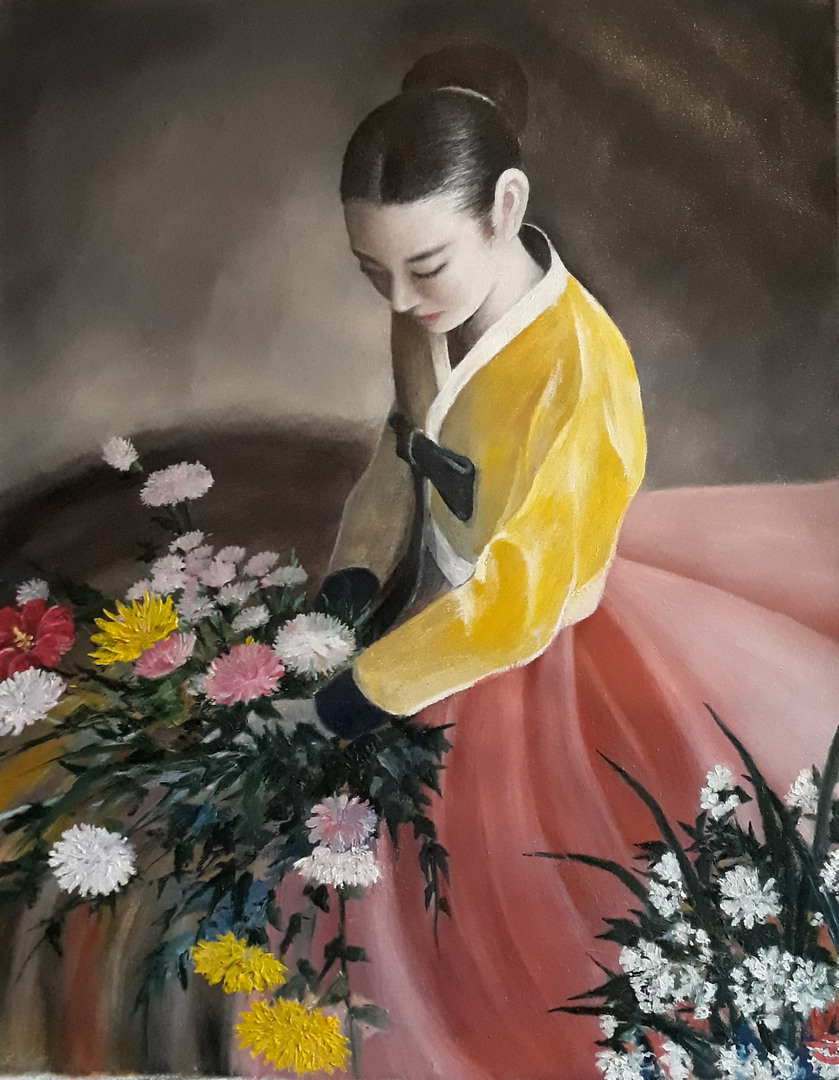
A young woman in a yellow jeogori and pink chima bends over a great bouquet of flowers. She does not look up. Her face is soft, private, absorbed. The flowers — chrysanthemums in white, pink, yellow, and red — spill across her arms like a waterfall of colour. She holds them with the care of someone who knows that beauty is fragile.
The inspiration came from a photograph I took myself while attending a relative’s wedding back in Korea. When I brought that moment to the canvas, I rendered the hanbok with the tenderness of someone who truly remembers what these colours mean — not as a traditional costume, but as living memory. For me, the yellow is the colour of autumn chrysanthemums, of old family photographs, of mothers and grandmothers. The pink is not merely decorative; it is alive and flowing, as if the fabric itself is breathing.
I made the background dark, almost a void. There is no room, no garden, no context. Only the woman and her flowers emerge from the shadow like a figure from a dream. This was deliberate. I wanted to strip away everything except what truly matters: the quiet act of holding beauty, and the calm dignity of a woman who does not need an audience to be beautiful.
There is something deeply Korean about this piece that goes beyond the clothing itself. It captures the way Korean women have always carried beauty — not for display, but as an inherent act of grace. In my painting, she does not pose. She tends. She arranges. She holds the flowers as if they might break, and in doing so, she becomes more beautiful than any of them.